Showing posts with label book review. Show all posts

Tuesday, September 20, 2022

Courageously Expecting

Shortly before this pregnancy, I came across Jenny Albers' (at the time not-yet-released) book, Courageously Expecting. It was advertised as a 30-day, Scripture-based devotional for women navigating the mingled joy and terror of pregnancy after loss -- which sounded wonderful, though I wondered (rather cynically) if I'd ever have a reason to read it. Lo and behold, five days after the release date I was holding a faintly positive pregnancy test. It took me two more months to actually order the book, a testament in itself to the protective layer of caution I'd wrapped myself in. Even then, I felt far from confident that this pregnancy would last -- but that was part of the reason I felt I should read it in the first place.


As I started reading, I was so glad I'd summoned up the courage (no pun intended) to place that order. It took me far fewer than 30 days to finish, because I couldn't stop reading! It was such a blessing to find someone who could relate to what I felt, but who also pointed to Scripture as the source of truth about both my past and my future. No empty, "feel good" mantras or affirmations -- just trust in the One Who is writing my story, even if that story involves more loss. Jenny is gentle, but doesn't beat around the bush; once you've experienced pregnancy loss, there is no comfort to be found in saying "of course it won't happen again!" In her words:

"It's hard to imagine your body producing a living being when you know so intimately its ability to destroy one." (pg 71)

Hope. It's a precious commodity when the line between life and death seems so fine, and so out of your control.

"Most people would say I was 'expecting,' but it was more complicated than that. What was I expecting? Was I expecting life or death? Was I expecting to leave the hospital with or without my baby? Was I expecting a full-term birth or an early death? And even in the case of a full-term birth, I knew I wasn't guaranteed to deliver a living child." (pg xvi)

The uncertainty can be crippling. Waiting, day after day, for the signs that your worst nightmare is coming true...again. Unable to say the words "when the baby's born," qualifying every statement about the future with the word "if." As someone who has always delighted in pregnancy, I have found it deeply saddening to lose not only my precious babies, but also the innocent joy of expectation. But:

"While pregnancy after loss isn't exactly the way we'd hoped to experience pregnancy, isn't it enough to help us cling to God's promise of a better day? Isn't today, with your womb full, a better day than when it was so heartbreakingly empty? Hasn't faith, even the smallest amount, carried you to this point?
God has given you this child right now, and even if you can't predict what the future holds -- even if you're scared and unsure and hope seems impossible to grasp -- might the life that's inside you right now be enough to spur you toward embracing that elusive hope in a tangible way?" (pg 123-124)


I'll admit, I was skeptical when I ordered this book, unsure of what kind of theology I would find in its pages. So many, even in the Christian community, are quick to undermine God's sovereignty in an attempt to make bereaved mothers feel "better." They clearly haven't thought through the implications of a god (little "g" on purpose here) who desires to spare us from pain, but is incapable of preventing it! But Courageously Expecting proved to be filled with Scripture that underlined God's providential work in our lives. Instead of skirting the issue, Jenny acknowledges that even the babies we've lost are part of His plan -- and just because we don't understand why they couldn't stay doesn't mean that plan (or its Author) aren't good.

"Remember this: we have a God who knows us better than we know ourselves. He knows where we're going even when we don't, which is why we can be comforted even when our sense of control dissolves in our hands. There is comfort when we realize that our pregnancies are in hands far steadier than our own, and that our lives are being formed into something good even when we feel defeated." (pg 202)

I feel like this post probably reads like a book advertisement (extra points if you pronounced that ad-VER-tiss-ment in your head!), but I couldn't help but share a book that was such an encouragement to me. While it didn't magically strip away my fears -- which would be an unrealistic expectation -- it helped me to process the emotions I felt and give voice to worries I was scared to verbalize. 

Of course, all women process pregnancy after loss differently. I don't recall feeling much anxiety with Laddie, my first "rainbow" pregnancy. I know I was concerned in the early weeks, but once we'd had a positive ultrasound and passed the gestation of our previous loss, that mostly vanished. This time, it's different. Six losses in a row, including one at 16 weeks, will challenge even the most persistent optimism. But at the same time, so much grief has also taught me something about the value of joy even in uncertainty. By 20 weeks, I felt mostly at peace. By 30 weeks I found myself saying, "when the baby comes." Now, at 38 weeks and planning a homebirth, preparation has been essential! Granted, I've been blessed with a blissfully smooth pregnancy so far, I've reached the "viability" milestone (when a baby has a good chance of surviving preterm birth), and am well past the point that we've ever lost a baby. But I'm not oblivious to the possibility of loss, even though I'm now in what's considered by many to be the "safe zone." If only there were such a thing! I know I can't guarantee the outcome I desire, but I also know that the precious life inside of me deserves to be celebrated, no matter what.


As we've been blessed to add children to our family over the past decade, I've sometimes felt wistful for my first pregnancy; that may sound odd, but there is just something magical about that once-in-a-lifetime experience of becoming a parent for the first time. Granted, I didn't want to relive all of it! Even the passage of time hasn't totally erased the memories of bewilderment as we navigated those early weeks. Each successive pregnancy/birth/postpartum stage has grown easier, as those stages become more familiar to both my mind and my body. But somehow, my twelfth pregnancy feels like a first pregnancy (not counting the almost constant sight and sound of this baby's four energetic older siblings!). I've taken more bump photos than any of my other pregnancies, thrifted and sewn maternity and baby clothes, and taken such delight in preparing for this much-anticipated baby. For many loss mamas, those activities are just too painful or scary to contemplate, even in the third trimester; each mama's story is unique, and so is her response. For me, I've been waiting for years, and I don't want to miss out because I was too scared to enjoy this answer to many prayers (both mine and others'). 

I'd highly recommend Jenny's book for those who are pregnant after loss. I'm incredibly grateful to be here, counting down the days to our sweet baby's arrival -- this moment in time seemed so unattainable for so long. But no matter my circumstances, I'm always, always, carried in the arms of the One Who gives and takes away, and Who gave up His very own Son for me. That assurance is my true hope, and allows me to enjoy every blessing He grants along the way. 


Tuesday, May 31, 2022

Inexpressible: On Rainbows, Babies, and God's Forever-Faithful Love

(If you're an Instagram follower, I'm afraid you'll find this a bit of a repeat from a few weeks ago! But I had more thoughts than I could fit in a caption, and I finished the book I was reading at the time. So here we are.)


This tiny necklace represents so much waiting, so much prayer, so many times of clinging to my heavenly Father in the midst of storms that threatened to sweep away my faltering faith. As I dreamed of a "rainbow baby" for over three years, I wistfully browsed rainbow necklaces and hoped I'd have a reason to buy one. I imagined the word "mama" engraved underneath, an exhale of relief and gratitude after our exhausting journey through the valley of the shadow of death. While Laddie is a rainbow baby, I didn't really discover the term until after his birth; it seemed odd to buy such a thing in retrospect. 

But every time I thought the sun was breaking through and our rainbow was finally coming, the storm clouds gathered darker and fiercer than before. The months dragged on, then years. Five would-have-been "rainbow" pregnancies, five more losses. With each loss, my faith was tested yet again, as if God were asking, "Do you still trust Me? Do you still believe I'm good?"

I waited until 12 weeks with my current pregnancy to order this necklace, and even then my sudden burst of "courage" was prompted by a sale! What if we were to lose the baby this necklace represented? How could I bring myself to wear it? While every passing week gives me more hope and we're quickly approaching the 24-week "viability" milestone, I don't yet know if this baby in my womb is my long-awaited rainbow. 

In the end, I didn't engrave the word "mama" -- but not out of a sense of caution. Rather, because there is something more important to me than being the mama of a rainbow baby (even as I long for that very thing).  You can bet there will be lots of rainbow accessories for this little one if our prayers are answered, but my feelings toward the term "rainbow baby" are a bit complex. A rainbow is the beautiful denouement to a storm, and in that sense a rainbow baby is the joy that comes after the intense storm of loss-induced grief. I've seen others who dislike the term, because they don't see their miscarried babies as a "storm," and I can certainly understand that -- but I see the loss of my precious babies (not the babies themselves) as the darkest storm of my life, and thus the term doesn't bother me on that score. 

But I've also seen the phrase "after every storm comes a rainbow" used to refer to babies born after loss, and that does rub me the wrong way. It's almost as if there's an expectation that if you miscarry, you will get a rainbow baby. Even worse, I've seen Isaiah 66:9 applied to rainbow babies, and often featured in pregnancy announcements: "'I will not cause pain without allowing something new to be born,” says the Lord." (New Century Version) Not only is this a very questionable translation of this verse (even when compared to other "loose" translations of the Bible), but it's being taken wildly out of context. The verse has nothing to do with miscarriage and rainbow babies, but rather God's plan for Jerusalem/Zion. And its misuse again implies that if you have a miscarriage, God will give you a "rainbow baby." There are many, many couples who have not been blessed with a rainbow baby, either biological or adopted -- was God not faithful to keep His promise to them? 

Which begs the question, what does a rainbow really represent? God appointed the rainbow as a covenant -- never again would He destroy the earth with a worldwide flood in (much-deserved) judgment for sin. It was His oath of steadfast love and mercy to humans who deserved no such grace. It was not a promise that I'd have a baby after loss. God's faithfulness is not determined by His providing "rainbow babies" (though He often graciously does just that, as I am personally and gratefully aware). Is there always a rainbow after the storm? Yes, in the sense that God never wastes pain in the life of a believer, and that He will one day redeem all of our suffering in eternity. As Elisabeth Elliot said, "Suffering is never for nothing." But that 'rainbow' may not take the shape of a baby, and it would be foolish, even dangerous, to pin one's hopes on such a thought.

That is why I engraved my necklace with the word "hesed." It is the Hebrew word found 248 times in the Old Testament, and most often translated as "mercy," "steadfast love," "lovingkindness," and "covenant faithfulness." I recently finished Michael Card's wonderful book on hesed, Inexpressible -- perhaps the title gives you some idea of how complex and beautiful this word is. He mentions in the introduction that translators often use two words to try to capture the essence of hesed, because a single word is rarely enough to express its meaning.


I found this wristlet for my keys from Dear Heart back in November, 
just before the third anniversary of Baby J's homegoing --
"no season is ever wasted" was quite a timely reminder.
I added the rainbow a few months later, as we rejoiced over our twelfth pregnancy!

In his preface, Card explains hesed this way: "When the person from whom I have the right to expecting nothing gives me everything." 

What a thought! I deserve nothing from the God that I have rebelled against, and yet He offers me everything. He sent His own Son to die on a cross, so that I might have eternal life that I did nothing to deserve -- or more accurately, I did everything to not deserve!

"The Bible reveals the God of hesed, who has opened the door of his life to you and me. Though we are responsible for the death of his only Son and have, in effect, cursed him, he covered us with his body, his blood, and saved us long before we might have accepted him. We have no right to expect anything from him, the Holy One. Yet he has extended himself to us, has invited us to enter his world, has made our story a part of his story, has opened his life to the inevitable possibility of being hurt, disappointed, and wounded by you and me." (Chapter 1)

"The great surprise of the Hebrew Bible is not that God is awesome or holy. These characteristics we would expect from God. The great surprise is that he is kind, that he is a God of hesed. This is what fundamentally makes him unlike any other god, then or now." (Chapter 4)

I was excited to find how many beloved Bible verses contain the word hesed -- I had studied this word in the past, and knew some of the more common English translations (especially "steadfast love"), but because it is translated in different ways it can easily become, quite literally, lost in translation. Here are a few notable verses:

Micah 6:8
He has told you, O man, what is good;
and what does the Lord require of you
but to do justice, and to love hesed,
and to walk humbly with your God?

Hosea 6:6
For I desire hesed and not sacrifice,
the knowledge of God rather than burnt offerings.

(note the poetic form in Hosea 6:6, where the 2nd line rephrases the first -- which means that hesed is linked to the knowledge of God. He is hesed!)

Hosea 10:12
Sow for yourselves righteousness;
reap hesed;
break up your fallow ground,
for it is the time to seek the Lord,
that He may come and rain righteousness upon you.

Hesed is part of who God is, and His unaccountable expressions of love and mercy to us should prompt us to imitate Him. God's hesed toward us enables us to show hesed to one another. Loving the "unlovable" should be a distinguishing mark of God's people, because we realize that we were truly unlovable, yet loved by God.

I liked Card's summary from chapter 11: 

"In the Torah, we discovered the definitive experience of God's hesed: God telling us who he is. In the historical books we witnessed the heartbreak associated with the violation of the hope of hesed. In the Psalms we listened to the unique resonance of the hesed our hearts were created and tuned to sing to. In the Prophets we meet the One who is himself hesed (Jer 3:12). 

The Prophets provide a portrait of the One who relentlessly reaches out to his people, who sends prophets like Jeremiah who weep and warn and plead with the people for decades before finally allowing the consequences of their sin to come into effect."

While the New Testament was not written in Hebrew, hesed is far from absent. As Card notes in his conclusion, "In Jesus of Nazareth, the embodiment of hesed, God was perfectly just and perfectly merciful. Through Jesus he fulfilled the promise to not leave the guilty unpunished by placing that punishment on Jesus in an act of pure and perfect hesed. Jesus did justice by loving hesed. He gave himself so that we might be conquered by the kindness of God, a kindness that leads us to repentance, that draws us to the cross. That moment in time makes doubting the lovingkindness of God impossible... As Frederick Buechner says, instead of being too good to be true, it's 'too good not to be true.'"

If you couldn't already tell, I highly recommend Inexpressible*. I'd rank it with Gentle and Lowly as one of the books that has most influenced my understanding of who God is. It reminds me of Job's words in Job 42:5, "I had heard of you by the hearing of the ear, but now my eye sees you." 


That is why I have the word hesed engraved on my necklace. While I hope and pray this baby will join us earthside this fall, our very own little "rainbow" after the darkest of storms, I will wear this necklace no matter what. I serve a faithful God Who always keeps His promises, Who has already done far more for me than I could ever ask or imagine, and Who never abandons me in the storms of life. 

Tuesday, May 11, 2021

Beneath the Seams: Counting the True Cost of Clothing

Over the past few years, I've become more and more disillusioned with the modern clothing industry. "Fast fashion" has made clothing cheap and virtually disposable to the consumer -- a fact that is exploited by swiftly changing trends that keep consumers coming back for more...and more...and more. Quality has plummeted along with cost, and sources suggest that for every five garments produced, the equivalent of three end up in a landfill. According to the EPA, 1.3 million tons of clothing and footwear were discarded by Americans in 1960. By 2018, that number had climbed to over 9 million tons, even though the population hadn't even doubled since 1960! As someone who values the resources God has given us, it saddens me to see so much waste. Cheap clothing may be easy on the wallet, but its ecological cost is high. 

But far worse are the inhumane manufacturing processes used to keep those prices tantalizingly low. Many factories (even some in the US) pay workers shockingly low wages, sometimes pennies per garment. And even in third-world countries where American dollars stretch further, that's far from a living wage. Working conditions are unsafe, benefits limited or nonexistent, and any worker who dares to complain can be easily replaced (because sadly, these jobs are better than many other options in third-world countries!). So much suffering, just to ensure that consumers can stuff their walk-in closets with garments they may never even wear before discarding them. 

I've learned to realize that if a garment on the rack seems cheap, someone is still paying the price -- it's just not me. 

And quite honestly, it's not just "budget" retailers that exploit garment workers. We've probably all heard of the infamous sweatshop, but may not realize that so many upscale brands rely on them (even if indirectly, by not making adequate efforts to ensure that their entire production chain is ethical). Mid-level brands like Gap and Anthropologie -- and even many luxury brands -- are guilty of this. So higher prices don't automatically guarantee workers were paid a fair wage.


********

One of my dearest memories from our time in Virginia was a women's Bible study that I attended. It was there that I met my friend, Peyton Roberts, who (besides being a delight!) encouraged me and helped me grow in my walk with the Lord. She invested so much into each of the women in that group. We had some fun connections, too -- we are both military spouses, both seamstresses, and the church I attended as a teen was across the street from her grandfather's house.


A happy reunion in March 2020!


So imagine my delight when I found out that Peyton was publishing a social impact novel about the fashion industry! I was blessed to read an advanced copy of Beneath the Seams -- which is being released today! 


The story is so powerful, and I was amazed by how seamlessly (no pun intended...) Peyton wove the dark truths about fast fashion into her writing. Even though I had done some research, I was horrified to find out just how dangerous and inhumane sweatshops can be. Shelby, the protagonist, was someone I could relate to in many ways, from her love of sewing to her struggles with secondary infertility and miscarriage. And I had a sewing business myself once upon a time! As the final few chapters unfolded, I couldn't stop reading; I was so invested in the characters that I had to find out how their stories resolved. I'm eagerly awaiting the copy I pre-ordered, which will soon have a home on my bookshelf. 

I'd highly recommend Beneath the Seams if you'd like to explore the consequences of fast fashion while reading a great story!

Peyton's Instagram and Linktree have some helpful resources, as well as more background for the novel and its author. And you can read the first few chapters over at Scrivenings Press.

In my next post, I'll share my own (imperfect) journey toward more ethical fashion.


Wednesday, April 28, 2021

Calvin in Gilead

When I started reading Gilead and With Calvin in the Theater of God at the same time, I little expected them to intersect. Calvin is rarely a name that surfaces in literature (especially modern), and when it does, it's usually a negative reference. Imagine my surprise to find the narrator of Gilead refer to Calvin positively. Though, to be honest, I didn't know what to expect from Marilynne Robinson. I've seen her books recommended often -- and often by fellow knitters, come to think of it! -- but this was my first foray into her writing. I wasn't disappointed. I wrote a bit about both books in my recent "book review" post, but thought I'd share some of my favorite passages. It's quite rare for me to mark passages in a novel, so that says something about Gilead!


I've delayed this post long enough that I'm far
past this point in my Grey Havens Sweater...


But I'll start with Calvin, which I found to be an excellent collection of essays not so much about Calvin himself, but rather about topics that he was passionate about. Each writer acknowledged Calvin's strengths and remarkable contribution to theology and church history, without "deifying" him or denying his weaknesses (he was human, and therefore a sinner, after all). Essentially, the authors glorified Jesus Christ, not John Calvin. Which is exactly what Calvin would have wanted.

As a mother, it's easy to feel that the "busyness" of my daily life detracts from my ability to serve God. But as David Mathis noted in his introduction, "It was the everyday life of suffering that produced [Calvin's] holy angst, the everyday life of disorder that begged for his arrangement, the everyday life of deadlines that prodded his productivity. It was an everyday life surrounded by distraught souls needing encouragement and deeply depraved sinners needing help with holiness. He simply would not -- could not -- have done what he did had he been tucked away in studious solitude, trying to maximize his isolation from the world and its fallenness."

Struggling with grief and loss comes with many challenges -- not least of which is the temptation to doubt God's goodness. Mark Talbot quotes Calvin in his essay, "Bad Actors on a Broken Stage:"

"No one will weigh God's providence properly and profitably but him who considers that his business is with his Marker and the Framer of the universe, and with becoming humility submits himself to fear and reverence."

Later, Talbot writes, "When bad things happen to us, are there ways to stop feeling that we have been given serpents for fish and stones for bread? In these situations, we need to know, Calvin writes, the Bible's promises that 'God's singular providence watches over the welfare of believers,' as well as to become acquainted with Scripture's examples of God's 'great diligence' in caring for his saints... it is primarily in and through our encounters with this world's sin and suffering that we begin to enjoy 'the immeasurable felicity of the godly mind.'" 

As a side note, reading Talbot's chapter has convinced to read his book, When the Stars Disappear, which I've been eyeing for a while.

I was also interested to learn more about Calvin's perspective on poverty, which Marvin Olasky tackled in his essay, "The Secular Script in the Theater of God." He writes that "many people throughout medieval times had heard that the best way to help the poor was to give them spare food, clothes, and coins. Tyndale's emphasis on agape rather than charity challenged that, and Calvin's theoretical writing, plus the policies he implemented in Geneva, showed in practice the meaning of agape. He taught and showed that the best way to tackle poverty was not to distribute alms, but to open a business and employ those who would otherwise beg. The understanding underlying Calvin's emphasis on helping the poor and the alien was simple: Everyone is created in God's image and is worthy of respect. He wrote, 'We cannot but behold our own face as it were in a glass in the person that is poor and despised...though he were the furthest stranger in the world.'"

In a culture where the words "justice" and "equality" have been mutilated into weapons by those with political agendas, or degraded by social media's virtue signaling, we would do well to look to Calvin -- who was looking to Jesus. If all humans are made in God's image, then all of the people that I meet deserve respect that is not dependent on their color, gender, class, or cultural background. If all men are descended from Adam, as the Bible teaches, there is simply no room for one human to feel superior to another. I'm made in God's image, and so are you.

I also appreciate Calvin's perspective on poverty, which deserves more than just a "band-aid" approach. I once read a Victorian-era novel that addresses this issue -- I wish I could remember the title! In the story, concerned citizens from local churches (not the government) established a homeless shelter whose residents were provided with (and required to) work. The work itself turned discarded material into a useful resource, which is its own lesson in creative sustainability. The idea was to provide the impoverished with life skills that would eventually grant them independence. In the meantime, their immediate needs for food and shelter were met. It still puzzles me why this model is not more common! Granted, it is far more "costly" than just donating money or goods, because it involves taking the time and effort to truly help others. 

But back to The Theater of God -- each essay was well worth reading, and I'm so pleased that this book caught my attention.   


There really is no good segue to Gilead; while I read these books at the same time, and found an unexpected "connection," that's where the similarity ends. 

It wasn't hard to warm to Marilynne Robinson's characters -- they seemed so real, even when I didn't understand their way of thinking. The narrator, a pastor in his 70's, was someone I'd like to meet. The book is reflective, written as a letter from father to son. As he near the end of his life, he recalls his own nuanced family relationships and the hardships that his community endured. A dying man in a dying town. Several of the characters have their own novels, which I think I'll have to read now. 

Here's the passage that connected this contemplative novel to Calvin:

"Calvin says somewhere that each of us is an actor on a stage and God is the audience... I do like Calvin's image, though, because it suggests how God might actually enjoy us. I believe we think about that far too little. It would be a way into understanding essential things, since presumably the world exists for God's enjoyment, not in any simple sense, of course, but as you enjoy the being of a child even when he is in every way a thorn in your heart." (pg 124-125)

It's not an easy book to read, because it's not the kind of story that's tied up in a neat little bow at the end. There is some resolution, but the book doesn't have a dramatic story arc to begin with. It just makes you think about life, about relationships, about God Himself. I don't quite understand all of the narrator's trains of thought, and think I disagree with a few things he said. But some passages were wonderful, like this one:

"But I wished to say certain things about the Fifth Commandment, and why it should be thought of as belonging to the first tablet. Briefly, the right worship of God is essential because it forms the mind to a right understanding of God. God is set apart -- He is One, He is not to be imagined as a thing among things (idolatry -- this is what Feuerbach failed to grasp). His name is set apart. It is sacred (which I take to be a reflection of the sacredness of the Word, the creative utterance which is not of a kind with other language). Then the Sabbath is set apart from other days, for the enjoyment of time and duration, perhaps, over and above the creatures who inhabit time. Because "the beginning," which might be called the seed of time, is the condition for all the creation that follows. Then mother and father are set apart, you see. It seems to me almost a retelling of Creation -- First there is the Lord, then the Word, then the Day, then the Man and Woman -- and after that Cain and Abel -- Thou shalt not kill -- and all the sins recorded in those prohibitions, just as crimes are recorded in the laws against them. So perhaps the tablets differ as addressing the eternal and the temporal.  

What the reading yields is the idea of father and mother as the Universal Father and Mother, the Lord's dear Adam and His beloved Eve; that is, essential humankind as it came from His hand. There's a pattern in these Commandments of setting things apart so that their holiness will be perceived. Every day is holy, but the Sabbath is set apart so that the holiness of time can be experienced. Every human being is worthy of honor, but the conscious discipline of honor is learned from this setting apart of the mother and father, who usually labor and are heavy-laden, and may be cranky or stingy or ignorant or over-bearing. Believe me, I know this can be a hard Commandment to keep. But I believe also that the rewards of obedience are great, because at the root of real honor is always the sense of the sacredness of the person who is its object. In the particular instance of your mother, I know that if you are attentive to her in this way, you will find a very great loveliness in her. When you love someone to the degree you love her, you see her as God sees her, and that is an instruction in the nature of God and humankind and of Being itself. That is why the Fifth Commandment belongs on the first tablet. I have persuaded myself of it." (pg 138-139)


It seems Gilead is one of those books that defies simple description. I'm reading Robinson's novel Housekeeping now, and find it much the same. They're the kind of books that challenge, stories that I mull over even when I'm not reading them. The closest thing I can think of is Leif Enger's beautiful novel, Peace Like a River, even though they're quite different. 

At any rate, I've rambled on long enough -- you'd be far better off reading the books themselves than my lengthy musings! Reading anything good lately? I'd love to know -- I'm always on the lookout for book list candidates!


Friday, November 04, 2016

Checked Out

Inspired by some of Cheri's literary finds, I decided to search my local library -- I've read Kate Douglas Wiggin's Rebecca of Sunnybrook Farm and New Chronicles of Rebecca (and thoroughly enjoyed them!), but hadn't read any of her other books. I was reminded, too, that it's been quite some time since I've read any Sarah Orne Jewett books.

My search turned up several gems, which were labeled as "in storage." Namely, Creeping Jenny and Other Stories by Kate Douglas Wiggin, and The Queen's Twin and Other Stories by Sarah Orne Jewett. I put them on hold, and shortly afterwards I was notified that they were waiting for my at my local branch. What I found were antique books, beautifully bound. This one, for instance, was just the 2,709th book to be added to the library system, back in 1929:

I wonder what constitutes a "Special Book?" And considering that the fine is still only 10 cents, I feel that the
fines were rather steep!


This one was a bit newer, but it still had its old-fashioned card -- the earliest date was 1979, and the latest was 1988. Which is a strange thought. People were checking out this rather obscure book before I was even born. I wonder who they were, whether they liked it as much I did, and if we had anything else in common?


I confess that Sarah Orne Jewett's writings have made me fall in love with early 20th century Maine, to the point that an extended vacation there (albeit in the 21st century) is high on my bucket list. I didn't realize that Kate Douglas Wiggin also hailed from Maine! So perhaps I really do just have a natural inclination for Maine, or people from Maine, or just stories written in/about Maine? At any rate, both were well worth a read -- simple, sweet stories about everyday life, told in such a charming way.

I'm sure the librarians were a bit startled that I was checking out something other than picture books...

Thursday, July 07, 2016

Thank you, Mr. Mayhew

Katie in London has been on my "Books for Littles" board for quite some time now -- I still can't remember exactly how I discovered it (quite possibly on one of my rabbit trails of "recommendations" from another book!), but it's taken me this long to finally look it up. Fortunately, our local library had both Katie in London and Katie in Scotland. If you've been a reader here for any length of time, you'll know that I'm a devout Anglophile, and these books are the perfect way to indoctrinate... I mean share... that love with my children. *wink*


These books represent everything I love in children's picture books. The illustrations are so charming and whimsical, yet accurate enough to give a real sense of the places that Katie visits with her brother Jack and her grandma (who is "the sort of grandma who likes adventures," by the way). And I do love the James Mayhew both authored and illustrated the books! The stories are sweet -- whether the children are gallivanting around Scotland with the Loch Ness monster, or touring London on a magical stone lion from Trafalgar Square (which Little Man pronounces "Fatralgar"). No fights, no bad attitudes, just charming adventures with stops at museums, art galleries, and famous sights.

Would I consider them successful with the younger set? Let's just say that I've been asked several times lately to fix Rosa's hair in two pony-tails "like Katie's," and we have been watching endless videos of bagpipers, caber tosses, demonstrations of the highland fling, and even the trooping of the color at the Horse Guards Parade (apparently fascinating to a 3 and 5 year old, despite its rather lengthy nature!). We've browsed through folders of pictures from my last visit to England (has it really been nine years?). But best of all, Little Man told me longingly that he hopes to go to England one day. And what do I say? "Amen to that!"

It may be a while before we make it across the pond, but we'll be reading plenty of Katie in the meantime. Thank you, Mr. Mayhew!


PS -- There are many other "Katie" books, mostly dealing with art, that I can't wait to explore! Mr. Mayhew has also written some about Ella Bella Ballerina, as an introduction to famous ballets. There's one about the Nutcracker that I should probably find for my Clara-obsessed three-year-old...

Monday, October 05, 2015

A Jane Austen Christmas: Review and Giveaway!

When a representative from Cider Mill Press approached me a few months ago asking if I'd like to host a review and book giveaway for a new Jane Austen book, my heart skipped a beat! Knowing that many of you share my love for Jane Austen, I didn't hesitate to send an affirmative response. I received my own copy of the book a little while back, and without further ado, will share my observations with you! If you'd like your own copy, have a try at the giveaway (below), or find it at Amazon here!


A Jane Austen Christmas: 
Celebrating the Season of Romance, 
Ribbons, & Mistletoe 

by Carlo DeVito


First off -- not to judge a book by its cover -- but this is a lovely little book! Bound attractively in red and green (you can see it peeking out in the photo), and jacketed festively, it's a well made book that's the perfect size for reading.

It's difficult to classify this book. It includes a bit of biography, a bit of historical info, and even recipes (mostly for festive holiday beverages, some of which are from the Austens themselves). Mr. DeVito tracks the Austens through the years, writing primarily about their Christmas-time activities. Each chapter/part focuses on a different year, starting in 1786.

One of my favorite aspects of the book was the connections between Jane Austen's experiences and the people she knew, and specific passages in her books. The infamous play from Mansfield Park? Jane had a similar experience when her own brothers vied for a young woman's attention during their own theatrics. Mr. Collins shows up, too, and Jane's unfortunate early romance with Tom Lefroy is detailed, as well as her exceedingly brief engagement to Harris Bigg-Wither.

DeVito draws from a variety of sources -- historical accounts, Austen family letters, etc. -- to paint a portrait of Christmas festivities in the Georgian and Regency eras. The bibliography is quite hefty for such a small tome. Including so many sources can result in a very choppy, cobbled narrative, but Mr. DeVito handled it quite well and the result is an easy read. Since I personally know very little about Christmas celebrations from that era of history, I found it quite informative! I also appreciated that he "suggested" how the Austens might have done things based on the traditions of the times, since we don't have exact accounts of all of their holiday activities.

As I mentioned, the book includes several recipes of the time period (mostly for alcoholic beverages, which is a bit of a specialty for the author), and gives some insight into how the Austens ran their kitchen -- Jane and Cassandra were actually quite involved, owing to their family's constrained finances. A Jane Austen Christmas certainly gave me a better sense of the time in which Jane Austen lived, especially the societal climate that influenced her books.

My only caveats with this book are relatively minor -- first, that a handful of grammatical errors were overlooked. None were very glaring, but it does make me wince to see such errors in print! The second, is that there are a few brief thematic elements that make the book suitable for slightly older audiences. There is nothing "very shocking," but I don't think I would have given this to myself at 12 (which is when I first started reading Jane Austen). Then again, I would most certainly be considered a prude by modern standards, so don't think that there is anything racy!

I felt that the book painted a pleasing vignette of Jane Austen's life, detailing some of the experiences that most shaped her development as an author. This is really the perfect book for a chilly afternoon by the fire, with a steaming cup of tea at one's elbow.


And now, for the giveaway! Cider Mill Press has generously offered to give a copy of A Jane Austen Christmas  to a "Thoughts and Thimbles" reader! Let's keep this simple, shall we? No liking, no following -- just leave a comment with your favorite Jane Austen novel, and enter the giveaway by clicking below!


The giveaway is open only to residents of the United States and Canada


The giveaway is now closed! Congratulations Hannah H!


a Rafflecopter giveaway


All opinions expressed in this review are my own -- I did receive a complimentary copy of A Jane Austen Christmas for the purpose of this review. Consider yourself informed! *wink*


Monday, October 20, 2014

Rosa's Favorite Read Aloud

I've had to excercise a great deal of restraint lately, as I've grown more and more excited about collecting children's literature. Now that I'm reading aloud more and more to the littles, I've been compiling a collection of books (here's my Pinterest board) that we own or would like to own/read. Little by little, I add to our collection. I like to take my time, selecting books that meet my particular set of criteria -- no bad attitudes, unaddressed bad behaviors, or diametrically different worldviews; lovely artwork; and a "worthwhile" story (though I do struggle to find much of a moral in "Sheep in a Jeep," which is one of our favorites... *wink*). I learned so much from literature as a child, and I want to share that with our children.

Lately I've been getting multiple requests per day for Rosa's favorite book (a childhood favorite of mine): Baby Come Out by Fran Manushkin, illustrated by Ronald Himler. It's not very well known, and only recently returned from "out-of-print" status. I'm so glad it did, because it delights me even more as an adult than it did when I was a child!


Whimsical illustrations accompany the charming story, in which a rather stubborn baby is coaxed to "come out" because she wants a kiss from her daddy. I love the way the baby is portrayed (very "tastefully" naked), as I think it emphasizes the concept of personhood before birth. 


I also love the attitude of the family -- no jealous siblings, no angst. Just a great deal of love and eagerness to meet the new baby. 


It has certainly sparked plenty of excitement with our littles, as they anticipate the arrival of their sibling! Little Man likes to talk to the baby, telling it that he loves it, and explaining that it must get bigger and then it can come out. It's delightful to share these moments with them, especially now that Little Man is old enough to understand a bit more. I can't wait to see, Lord willing, their reactions when the baby does come! I wonder how many times we'll have read Baby Come Out before then?


Wednesday, July 31, 2013

All Dressed Up and Nowhere to Go (A Review of "Lessons From Madame Chic")

I've already mentioned that my wardrobe's been in a state of chaos lately. To tell the truth, I've been enjoying the process of overhauling my closet. I've basically gotten to start all over because so many of my clothes were worn out, impractical for a nursing mom, or just no longer my style. This time around, I was determined to create a wardrobe with fewer items, more function, and less "I have nothing to wear!"

It was while I was exploring the concept of a capsule wardrobe that I came across Jennifer Scott's blog, The Daily Connoisseur. I was instantly hooked! Her "Ten-Item Wardrobe" was an inspiration. And don't worry, it's not quite as drastic as it sounds. The idea is to have ten core items in your wardrobe each season, but it doesn't count staples like camisoles, tees, blazers, formal dresses, etc (though going overboard on "extras" will, of course, be counterproductive). Overall, the point is to have a small wardrobe of items that work together. That way, you're not overwhelmed by the choices (and possibly guilt) of an overstuffed closet, and every day it's simple to pick an outfit you love. If ten is too few, Jennifer suggests trying for fifteen or twenty core items. I won't go into too much detail here, because Jennifer says it much better on her blog! Here's a helpful post: Ten-Item Wardrobe: Getting Started. And here are all of her posts labeled "Ten-Item Wardrobe".

As I worked my way through Jennifer's archives, I became more and more determined to get my hands on a copy of her book, "Lessons from Madame Chic: 20 Stylish Secrets I Learned While Living in Paris." I ordered it through inter-library loan, and once it arrived I polished it off in a few short days.


Image taken from the author's website

While I'm usually not attracted to this kind of "self-help" reading, I thoroughly enjoyed this particular volume! Jennifer's style is delightful, and her encouragement to savor the everyday things in life is certainly worth noting. I especially appreciated her challenges regarding why we use our nice things only on special occasions. Why save them, when we could enjoy them daily?

As a note, my philosophy is a bit different from Jennifer's because of the Biblical principles that I value -- for instance, I don't want to dress nicely because I think I deserve it or I'm worth it. I want to dress well as a reflection of my Creator's beauty, and as a way to bless my family and those around me (though I will, of course, get some personal satisfaction out of it). But overall, I was able to apply a Christian perspective to just about everything she presented. 

[10/2018 Update: Since writing this post originally, Jennifer has become a bit more transparent about her beliefs on her blog and it is quite obvious that she is a Christian. I thought back to this review, and hope that my comment about a "Christian perspective" did not imply that I was assuming she wasn't a Christian, or that her book was lacking in any way simply because I disagreed with some of her perspectives -- hopefully my overwhelmingly positive reaction to her book (and the two which succeeded it, which I've also enjoyed very much!) made that clear. But just in case, I thought I'd clarify it here!] 


Look Presentable Always

One of her suggestions is to "look presentable always." I love that! Do I want my children to remember me as someone who only dressed up if I had somewhere "special" to go, and spent the rest of my time in yoga pants and a messy ponytail? This is not a new concept to me, as evidenced by the lack of "loungewear" in my closet. I'm used to cleaning and cooking and cuddling in clothes that most people would consider too nice for "around the house." After all, at my local thrift shop, a nice top is the same price as a dingy tee shirt, so why not?! But being a momma to two littles can be exhausting (I know those of you with four or more are probably laughing dryly at that comment...), and I've found myself slipping a bit in that area lately.

Jennifer suggests wearing aprons during messy tasks, in order to protect your clothes. It's a little easier to wear your "nice" clothes when you're not worried about splatters of spaghetti sauce! I'm notoriously bad about remembering to wear aprons, but I've turned over a new leaf. Making a new apron that I love to wear has certainly helped!

Another positive about Lessons From Madame Chic is that it does not encourage some kind of artificial, high-maintenance beauty routine. Instead, Jennifer suggests that you find a low-maintenance look -- something that's feasible for every day (that's the point!). She encourages what she calls "le no makeup look," which are a few minimalist looks designed to enhance one's natural beauty. 


Counting the Cost

I quickly realized that Jennifer's suggestions of brands and retailers would not work for me. I simply cannot afford most of the labels she buys. I think one season of her ten-item wardrobe would be about what I'd spend on my whole wardrobe for at least five seasons! Also, some of the fabrics she prefers (like silk and cashmere) require dry cleaning; I don't think I've stepped into a dry cleaner's since I got married 3 1/2 years ago... But that's okay! I have a different style and budget. The principles of the book aren't ultimately dependent on having a huge income, or on buying specific items or brands; Jennifer points out that you can make the ten-item wardrobe work on any budget. 

While we're on the topic of cost, I was pleased to find that Jennifer promotes less consumption, rather than more. I expected a certain amount of materialism from a book about living well. But according to Jennifer, the Parisians she met were not interested in obtaining the newest, latest, greatest "thing." They valued quality over abundance -- which makes sense when you consider the ten-item wardrobe. 

I've also been able to implement some of the book's principles by finding cheaper (and more natural) alternatives to some of the beauty products she recommends. I'm very much a minimalist when it comes to makeup, but I've realized lately that I'd like to experiment a bit. Lessons From Madame Chic has helped me realize I can do that without looking artificial (via le no makeup look). Now that I have the materials I need, it's time to experiment and come up with a skin care and makeup regimen that works for me!


What This Looks Like For Me

Much of what Jennifer proposed was not new to me, but her presentation helped me realize that I want to make more of an effort to incorporate those ideas into my day to day life. I'm thinking specifically here about music, the arts, and reading. Like Jennifer, I've been blessed to live in and visit certain places where the museums are free, the art galleries are abundant, and even the buildings lining the streets were designed by masterful architects. My current locale is not one of those places. But that's hardly an excuse to throw in the towel. While I hope life in the military will take us to many places rich with culture, it will almost certainly also take us to "ordinary" places, too. I'll need to be creative in finding ways to incorporate culture into our lives.

On a different note, reading this book also made me realize that it's high time I paid more attention to my skin. That's something you only have one shot at preserving, and I'd rather put in some effort now than regret having neglected it when I'm 40. I can't afford the professional massages, facials, and mani-pedis that Jennifer recommends (that lifestyle seems very foreign to me, since I've had a total of one mani-pedi in my entire life!), but I can certainly do my own versions at home! French clay for facials is inexpensive, and the oil cleansing that I've started implementing recently has already improved my complexion. I've been more self-conscious about my skin recently, so Jennifer's suggestions were perfectly timed.

As for my closet? As a teenager, my walk-in closet bore painful witness to my thrift shop "addiction." I had about three feet of rod devoted to tops, skirts, and dresses -- each (though my dress section did include my then-substantial costume collection). Granted, I paid less for all of my clothes than I would have spent on just one high-end designer dress. Nonetheless, I had far too many clothes, and I still had difficulty creating outfits! I let my fondness for shoes run rampant, as well. I had no plan, and just purchased whatever appealed to me and fit into my budget. As a result, I had so many clothes that nothing I owned wore out, and I became bored with seeing the same items over and over again.

I've been slowly reigning myself in over the past few years -- two years ago I enacted a self-imposed shoe fast, and decided to not buy any new shoes until I wore out the pairs I already had. I had multiple pairs for each "style" (flats, heels, sandals, etc.), so when my last pair of a specific color and style wore out, I allowed myself to re-purchase equivalent shoes. I was tired of buying shoes (either new/clearance or thrifted), only to have them sit in my closet for years without showing the slightest signs of wear! As much as I enjoy shoes, I don't need to have two or three dozen pairs.  

Similarly, my wardrobe has shrunk dramatically over the past few years, thanks to pregnancy and a little more self control on my part. Jennifer's observations gave me the last little push I needed, and I'm almost to where I want to be. My summer wardrobe consists of about two dozen tops (that includes tanks, cardigans, etc.), five dresses, eight skirts (one of which I haven't actually made yet), and ten pairs of shoes (which will be five pairs in the fall, when my four pairs of sandals are put away). My maternity clothing fits in one large tub, and my winter wardrobe fits in a single under-the-bed bin. 

I don't technically have a capsule wardrobe, because not all of my tops go with all of my skirts. But I don't have anything in my closet that doesn't go with something else! That's a first for me. I've been picky this go around, and I really like everything in my closet. Part of Jennifer's inspiration was that French women have just a few quality items, and are not at all embarrassed to wear them repeatedly. While it sounds boring to 21st century Americans, I'm finding that when I love what I have, I'm excited to wear it again (though I'm still having trouble convincing myself to go ahead and wear a favorite outfit, rather than "save it"). And though I was skeptical of Jennifer's claims that she doesn't feel the urge to shop now that her closet is minimal, I've found it to be true! I'm reluctant to risk adding unneeded items to my closet (which I'll inevitably end up regretting), and find that I'd rather just skip the shopping and stick with what I have. I'll get to shop (and/or sew) when the season changes, or when one of my staple items wears out. It's a blissful feeling to be (mostly) free from the "want." 


In Conclusion

I think I'll post about my wardrobe in more detail soon, so I'll leave it at that for now! Suffice it to say, Lessons From Madame Chic was well worth the read. Jennifer covers a multitude of topics, from music to manners to how casual our culture has become. There are so many ideas for incorporating beauty and joy into everyday life! And I could always use a little encouragement to develop good habits.

I'd highly recommend The Daily Connoisseur if you're interested in reading more first-hand. Jennifer's taking a summer break, which is giving me the opportunity to work my way through the archives and take mental notes. It's been a refreshing and inspiring journey so far! 

Saturday, June 30, 2012

Living Large -- A Review of "Large Family Logistics" by Kim Brenneman


My sweet mother gave me a copy of Large Family Logistics: The Art and Science of Managing the Large Family for my birthday -- at my request, so it wasn't a hint on her part! *wink*

I was really curious about this book, though I thought I was probably getting ahead of myself. After all, though we hope the Lord blesses us with many children, we currently only have one child and one-on-the-way! I wondered if any of its contents would be applicable now, or if I'd have to stow it on the shelf in the hopes that one day I'd actually need it.

However, Kim opens up the preface with this:

"Many years ago, I was the mother of one small baby boy in a little rental house. My husband and I were committed to having me stay at home to raise our little boy. I remember being embarrassed because of the dust, laundry piled up, and dirty dishes, and I scrambled to make something for supper just minutes before my hard-working husband came home. Why couldn't I handle the basics? My shortcomings as a homemaker frustrated me... I was rich compared to women throughout the ages, and I knew it. What was wrong with me?"


As soon as I read that, I knew I was in the right place!

I really appreciate that Mrs. Brenneman starts out with Scriptural examples, attitude, and self-discipline. This is not a gimmicky "Revamp your life in three easy steps" book! There is Scripture sprinkled generously throughout the book, which helped me stay on track as to why these things are important.

Once the foundation has been laid, Mrs. Brenneman goes on to provide advice and ideas on virtually every area of family life. Laundry, cleaning bathrooms, homeschooling, gardening -- it seems that nothing escapes her notice! Much of what she writes is definitely geared for families with many children (as the title suggests), but I found that most of it was still helpful for me. I'd rather implement many of these practices and systems at the beginning, so that should the Lord bless us with many children, our household will continue to function smoothly (apart from the inevitable "bumps" of life, of course). The chapters are generally short and easy to digest, making it simple to either read the book cover to cover or to find a specific topic.

Personally, the book convicted me in a number of areas where I have been falling short due to lack of self-control. I don't mind work per say, but I don't much like work that I find disagreeable! Laundry I can handle, because I like it. I don't generally fall behind. Cleaning bathrooms? Not so much my thing.

There's also the token section on decluttering, which seems to find its way into every book on homemaking these days!  Quite honestly, despite the fact that we're just starting out and don't have a large house, I'm just tired of having so much stuff. Or rather, having more stuff than we need or use is hindering, not helpful. So encouragement in that direction was appreciated.

One aspect of the book that I liked was Kim's flexibility. By that I mean that she doesn't set up some Martha Stewart utopia of perfect housekeeping. She talks about stages in life where disposable plates and cutlery might be what your family needs, or how the systems she describes will need to be tweaked for individual families. I didn't feel that there was a "one right way" mentality to the book, and Kim doesn't put you on a guilt trip if you can't "do it all."

Okay, now for my critiques! Most of them fall under the "trivial" category, in that they don't affect the message of the book.

First, this thing is huge -- I found the layout strange, and the plethora of entirely empty pages was a bit annoying. I love the cover design, but the 8 1/2" by 11" size is rather inconvenient. Insignificant, perhaps, but it made on-the-go reading an impossibility. Forget large family logistics -- let's give a little attention to large book logistics!

Probably my biggest critique was actually the editing! Really, I was astonished by the number of grammatical errors in this book. The most glaring was probably the plural of baby being spelled baby's. But that's just one of many, many errors. I've never seen so many grammatical errors in a published work. I don't blame Kim for this (I don't think being a grammarian should be a prerequisite for writing a book!), but whoever was responsible for editing was very negligent.

My only content-related critique is that I thought the book occasionally falls into an unnecessarily dogmatic tone about areas that really come down to personal preference. As I mentioned before, Kim's advice is generally quite flexible. But there were a few sections that seemed to elevate the author's preferences a tad too high, in my opinion (even when I personally agreed with her preferences). A "this is the only way to do it" attitude tends to rub me the wrong way. Still, I wouldn't consider it a very serious issue, especially since the majority of the book does not come across that way -- and perhaps others would not even agree with me that this is even present in the book. Still, I suppose a book review is inevitably influenced by the reviewer's opinions. *wink*

Now that it's been a while since I read the book (this review has been sitting in my drafts for some time...), I think a re-read is in order. For me, there is no such thing as too much encouragement in the right direction when it comes to homemaking!


Monday, September 28, 2009

A Journey


Every book is a journey. Every author takes you on a trip -- sometimes to a distant time or place, sometimes to a brain-bending idea or concept. Some of the journeys are short, and some are long. Very long. Very, very long.


This was a long journey. Fortunately, it was well worth it! At 704 pages, Clementine Churchill: The Biography of a Marriage could definitely be classified under the "Investment" category. Mary Soames, the Churchill's youngest child, certainly had the first-hand experience to write such a book. Pulling from letters, her mother's stories, and her own life, Mrs. Soames paints an amazing portrait of her parents' extraordinary lives. Clementine devoted her life to her husband and his career, often at the expense of her own personal interests and talents. I think that was the aspect of Clementine's life that inspired me the most.

A journey to a not-so-distant time and place, through some of the most important events in Western history and some of the least significant events in the life of a family. Yes, this journey was worth it.

Friday, February 27, 2009

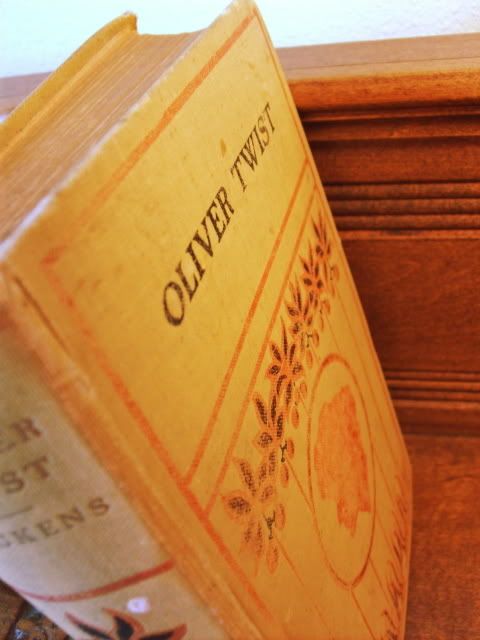
Oliver


I'm currently on a Dickens kick, prompted by a combination of a Dickens biography and the Dickens adaptations on Masterpiece Classic. I made it several pages into The Pickwick Papers before postponing it in favor of Oliver Twist (after watching the conclusion of the adaptation of that novel last week). It's been so long since I've read Oliver Twist that I hardly knew what to expect -- I was delighted by what I found.


Oliver Twist can be depressingly dark at times -- its themes are undeniably painful, and Dickens does not scruple to take you to the lowest rung of the social ladder. But the ending is worth the journey through the mire of London's criminal world. And any novel is more enriching when it's a copy that was published a hundred years ago and has been "well rubbed" at the corners. Somehow it makes me feel that I get to share my pleasure with the original owner!

Wednesday, September 24, 2008

At Peace

I try to keep a steady supply of books-on-tape coming from the library, to keep me company as I sew and craft. I recently stumbled across the name of Sarah Orne Jewett, a 19th century woman who wrote about life in Maine. Lo and behold, the library had a copy of her most famous novella, Country of the Pointed Firs, and also A White Heron and Other Stories. I had read a brief tidbit of Sarah's work in my college American Lit class, but only for class. Little did I know what I missed as I skimmed that section.

Sarah's delicate renderings of a summer on the coast of Maine are like a beautiful watercolor -- she catches the tone, the depth, the color of every character she describes and every incident she records. She paints a scene with her pen, bringing it to life in some mysterious way. I have always been fascinated by Maine, by the craggy and breathtaking landscape of its coastline; now I understand why. I was unwilling for the story to end. As it came to a close, I felt a sense of loss. I had grown to love Mrs. Todd and her sweet mother, the wise old sea captains, and the anonymous narrator herself, as if they were real people. I long -- I think every person longs -- for the peace and simplicity that Sarah describes in daily village life. Simple, it may be called, and yet deeper and more real than any other kind of living. As the narrator looked back with regret on a summer at Dunnett Landing, I longed to be by her side as the ship pulled out of harbor -- if only to catch a glimpse in person of the beauty and simplicity she had painted on paper. I don't often feel such pain -- or such peace -- when I finish a book. It's a good thing I still have A White Heron to listen to.

Monday, September 15, 2008

Time Travel with Sarah Morgan

While we were on our trip out West, I mentioned that I was reading Sarah Morgan: The Civil War Diary of a Southern Woman. While I didn't manage to finish it on our trip, I did read most of it (let's just say we had a long wait for our flight out of Las Vegas!) and completed it shortly after we returned.

Sarah Morgan's life sometimes reads more like a novel than like real life. I felt like I knew Sarah by the end of the diary, as if I would recognize her if I saw her on the street. Sometimes I felt a twinge of guilt as I realized that I was reading a girl's innermost thoughts!

Sarah's diary is also an invaluable resource for understanding the customs and costumes of the South during the Civil War. She makes frequent allusions to her dresses (just as any young woman today might!), and describes their delicate frills with an enthusiasm that warms the cockles of any historic costumer's heart!

I particularly enjoyed this lament:


"I was so mortified this evening! in going there, just as I got to Dr. Enders' corner, a gust of wind exposed my feet fully to the gaze of a party of officers who were contemplating me from Heroman's balcony. I hardly know which I hated most; the men for seeing, or myself for exposing my feet." ~ July 21st, 1862 (pg. 169)


How many young women today, I wonder, would be horrified that their feet were exposed to view!

I also appreciated Sarah's strong faith, which permeates her diary. Throughout the struggles she encountered during those horrible years -- losing her dearest brother in a duel and losing her father to illness shortly after; fleeing from her home; being thrown from a carriage and in danger of losing her life; spending a year as an invalid in constant pain; and worst of all, losing two other brothers within a week of each other, just before the end of the war -- Sarah relies on her heavenly Father and trust in Him no matter what the circumstances. I found her story inspiring, as she faced difficulty after difficulty without losing her faith in her Savior.

Sarah's diary is a mixture of pain and pleasure; horrific fears for her home, family, and country are mingled with parties and excursions that seem out of place in the war-torn South. After reading the introduction, I was horribly afraid that I would find the diary simply a string of feminist rants -- I don't think I have ever read such a misleading introduction!

I highly recommend Sarah's diary -- it is fascinating on many levels, and is a valuable resource for any interested in the Civil War. Sarah herself sums up the feelings of many in her era, as she begins a new volume in the middle of the war years:

"A fresh volume! Where shall I be at the end of it? Will I be once more seated at my old desk in my dear little room, comfortably settled at home? Or will I have no home then, and be what to me is worse than death--a wanderer who has no spot that may be called "home"? Will the blank pages record the burning of Baton Rouge, and the loss of our all? Will the close of it find me still running, or at last settled in what is to be our future dwelling in New Orleans? Will they leave us at Peace, or in war? Who knows? Leave it to Destiny. Write page after page, day after day, and mark the final event. It takes many days to bring about such a result; make them fly past, and thank Heaven that is one day nearer the end. Wait patiently, I say. This war cannot last for ever; and then comes blessed Peace! Will I be able to appreciate it?" ~ August 4th, 1862 (pg. 189)

Wednesday, February 27, 2008

A Humorous Look at Housekeeping


Last August I picked up a thrifted copy of Keeping Up With Keeping House: A Practical Guide for the Harried Housewife by the Former White House Housekeeper by Mary Kaltman. Published in 1971, I have found it to be a delightful trove of helpful information and humorous anecdotes. I had to include one of my favorite passages:


“My mother used the same brand of powdered detergent for years, and she used it for everything: dishes, fine fabrics, cleaning woodwork, mopping the floor, and doing the washing. It was a household fixture, satisfactory in every way. She was frightfully upset when the manufacturer upt enzymes in it, and I understand her reaction. Hers is a small rebellion against a surfeit of exaggerated claims and a plethora of products – more every day, and not all designed for use instead of an old product, but in addition to it. There’s a product for every specific purpose and almost every specific person. At the present rate of proliferation I can easily see what may happen to my favorite old scouring powder:

BOFO – A scouring powder. For everybody. For use anywhere scouring powder is needed.

could change to:
BOFO – With ABC added. For cleaning kitchen sinks or bathroom fixtures in either city or country houses.

to:
BOFO – With ABC and Sonjz added. For cleaning kitchen sinks in city apartments.

to:
BOFO – With ABC, Sonjz, and purple crystals added. To use in the feminine bathrooms of country houses. For cleaning bottom of bathtub only.

to:
BOFO – With ABC, POF, Sonjz, Jazzl, and purple crystals added. For use by male apartment dwellers under five feet. To clean outer rim of sink when kitchen faces west.

and finally to:
BOFO – A scouring powder with ABC, POF, XYZ, Sonjz, Jazzl, Zanky, purple crystals with green centers, and plain shocking pink crystals added. For use by women over thirty who have brown hair, blue eyes, live east of the Mississippi in houses with brass owl door knockers."


Her prophecy has proved true, as the word "scouring powder" is now practically obsolete. I shall now check all of our household cleaners to see if they contain "Jazzl" or "Sonjz." I find myself envying the housekeeper who could wash the clothing and the floors with the same cleaner!

At any rate, I hope you had as good a laugh from this as I did!